Insights
The USPH standards answer everything except which rule applies here
The CDC Vessel Sanitation Program sets out 1,596 separate requirements across two documents. On board, the only question that matters is which of them apply to this space, in this phase, today. We built a free app that answers it.
A chief engineer preparing a galley for commissioning does not need the Vessel Sanitation Program in full. He needs the requirements that apply to a galley, in commissioning, on the ship in front of him. The CDC publishes the first. Nobody publishes the second.
That gap is where USPH preparation usually goes wrong, and it is not a gap in knowledge.
The scale of the source
The CDC Vessel Sanitation Program runs on two documents. The VSP 2025 Construction Standards govern newbuilds and major renovations. The VSP 2025 Environmental Public Health Standards govern the ship once it is operating.
Broken into single requirements, they come to 1,009 and 587. That is 1,596 individual obligations spread across 25 areas, from the galley to the pool, and across four phases, from plan review through construction and commissioning into operations.
Both documents are organised the way documents are organised: by subject, in sequence, as continuous text. Work on board is organised differently. It happens in one space, in one phase, on one day, usually by a team that is responsible for that space and nothing else.
Nobody reads 1,596 requirements before walking into a galley. They look for the ones that apply, find some of them, and work from what they found.
Where the information has to arrive
We have written before about the gap between where a plan lives and where the work happens. On a cruise newbuild it is physical. The plan sits in the site office. The work sits four decks down inside a steel hull, where there is often no usable network.
USPH preparation inherits that problem exactly. The standards are available to everyone. Getting the relevant twenty requirements into the hands of the person standing in the space, at the moment they are standing in it, is a different task, and it is the one that decides whether a finding shows up at inspection.
This is a flow problem. The information exists, it is correct, and it does not reach the point of work in a usable form. That pattern is familiar from material, from drawings and from punch lists. Compliance behaves the same way.
Findings repeat, which makes them predictable
VSP publishes its inspection reports. We went through 871 of them, covering 2022 to 2026, with more than 25,000 individual findings between them.
The useful property of that record is repetition. Ships fail on the same things. A finding that appears in hundreds of reports across different operators and different yards is not carelessness on one ship. It is a requirement that is systematically harder to meet, or easier to miss, than the others.
That turns preparation into something you can prioritise. A daily round that starts with the checks that most often produce findings catches more than a round that works through the standard in document order. Frequency is evidence, and it was sitting in public reports.
What we built
Sightyard USPH is a free web app for cruise ship teams. It is a module of Sightyard, our outfitting control platform, and it is our own product.
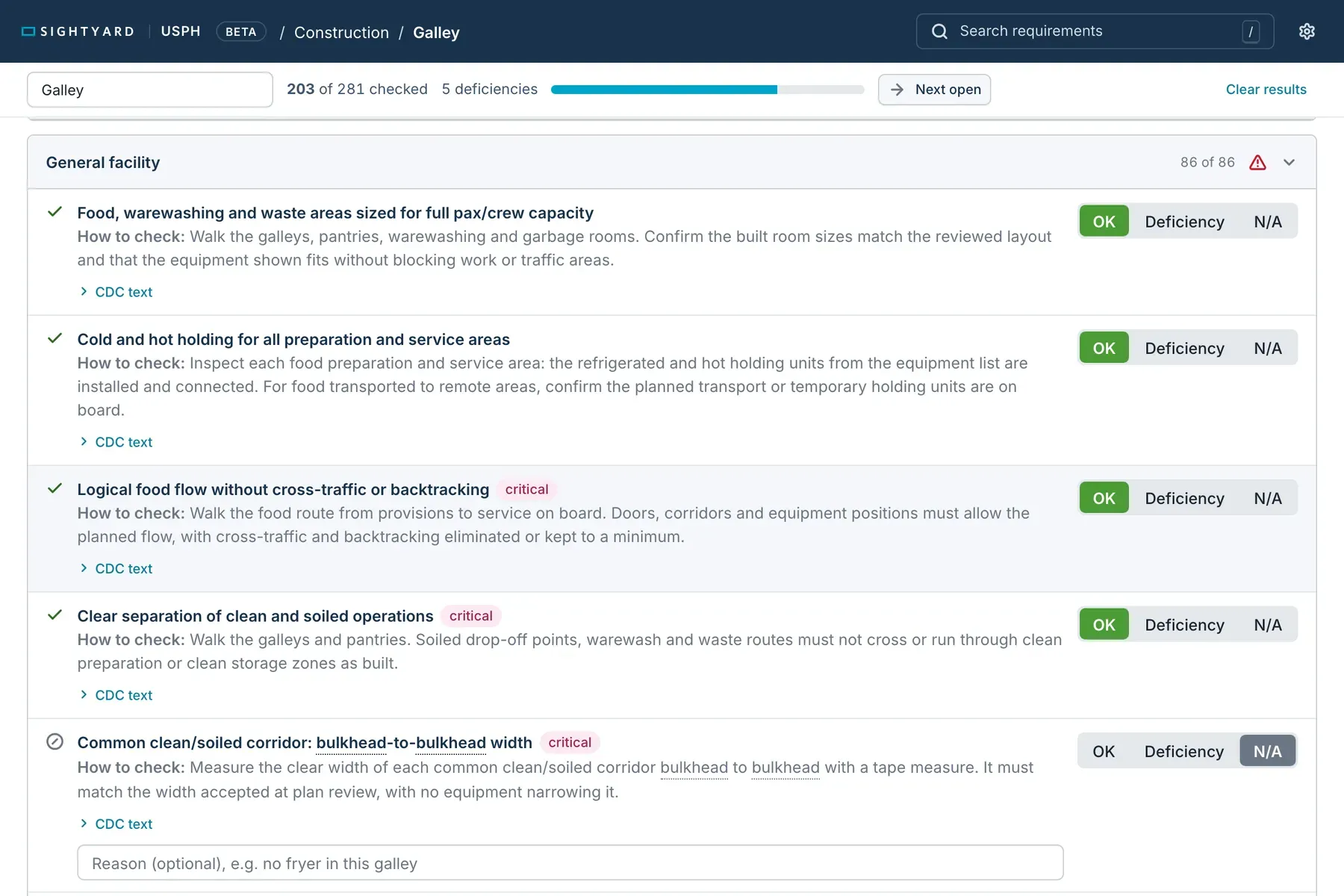
It splits both CDC documents into single requirements and sorts them by phase and by CDC area. Select galley and commissioning and you see what applies to a galley in commissioning. Each requirement carries a short check text that says what to look at, and the CDC wording it comes from is one tap away.
The check texts never add anything. They do not introduce a duty, a record or a frequency that the CDC text does not contain. Where the standard says "should", the app says "Recommended" and leaves it there. Independent reviewers went through every requirement, every daily check and every quiz question against the CDC source, in several rounds.
Beyond the requirements there is an inspection mode for walking an area and marking each item OK, deficiency or not applicable, a report at the end of it, 195 daily checks arranged as 15 station rounds for the running ship, a countdown to the next US port call, and 170 quiz questions for crew training.
It runs in the browser on a phone, a tablet or a laptop, and it works offline once loaded, which is the only state that matters inside a hull.
What it does not do
VSP decides. The app prepares. It does not replace plan review, it does not replace an inspection, and it is not affiliated with or endorsed by the CDC. Section numbers refer to the 2025 editions as published.
It is also in beta. Corrections are welcome and they get read.
Using it
The app is free. Requirements, check texts, search, guides, daily checks, the quiz, and an inspection with a report for one area need no login at all, and results stay on the device. A free account adds a report across all areas, PDF export, photos attached to findings, and sync between phone and laptop.
Open Sightyard USPH or read what is in it first.
If you are preparing a newbuild for its first US port call, or a ship in service for its next inspection, the fastest thing you can do with it is pick one area, walk it, and see what the report says.