Insights
Takt in the Drydock: One Rhythm for Contractors, Yard and Logistics
A classic drydock plan shows dependencies. It does not show where crews collide, when material is required or which inspection blocks the next job. A takt plan sets one clock for everyone, and deviations show up within the shift instead of in week three.

A drydock runs well when contractors, yard and logistics work to one rhythm. That rhythm is the takt.
Takt time and synchronisation are central to industrial production. In a drydock the same principles apply, only stricter. Synchronisation, stable processes and deviation management decide how well a dock is executed.
A classic drydock plan is a network of activities. It shows dependencies, but not where crews collide, when material is required or which inspection blocks the next job. Each party plans its own part. The gaps show up on the dock floor.
A takt plan sets one clock for everyone. Every trade, delivery and inspection follows the same beat, like the sections of a large orchestra under one conductor. Deviations show up almost in real time.
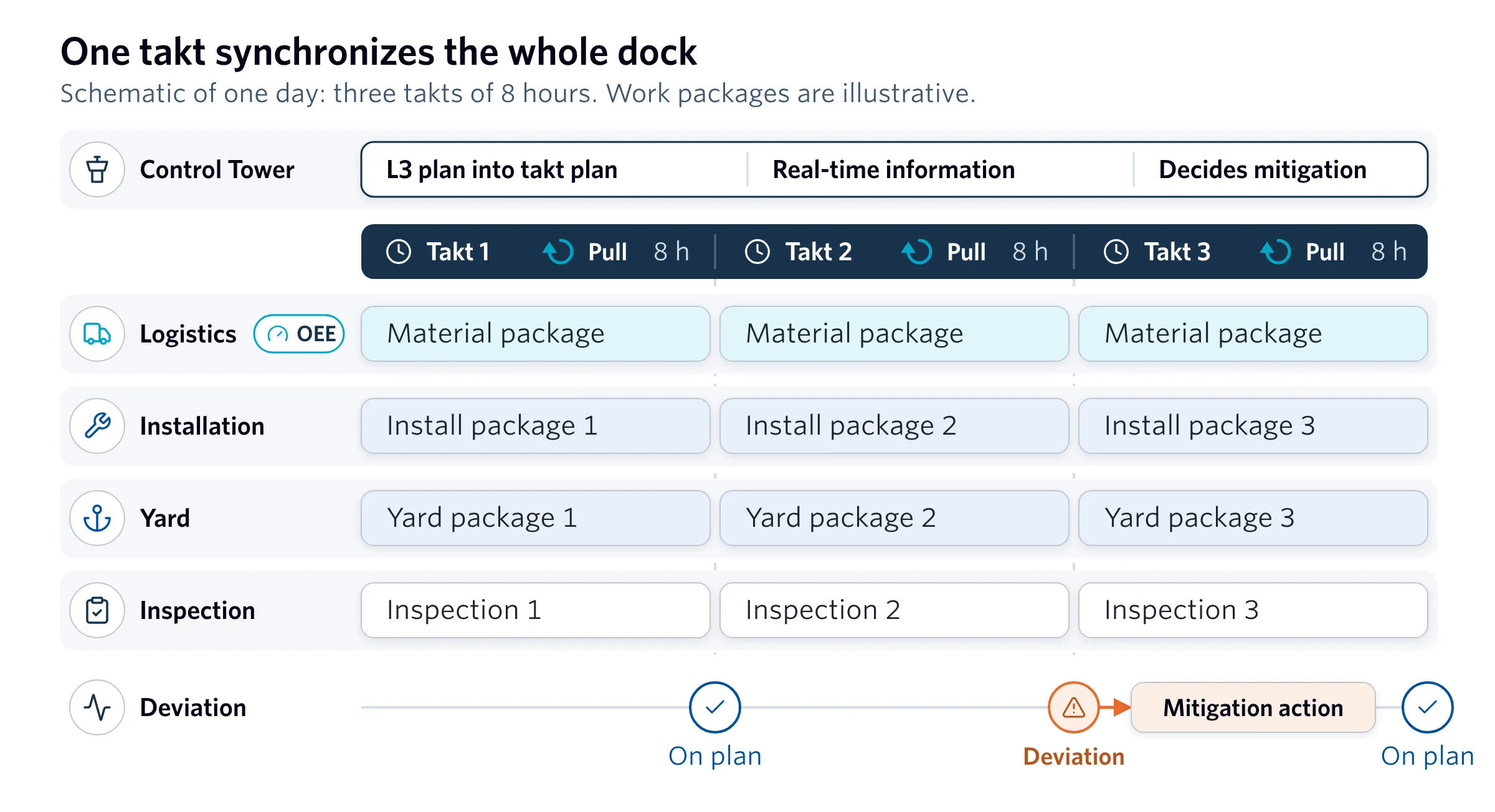
The Drydock Control Tower turns the L3 plan into the takt plan and feeds it with real-time information. The takt then creates flow, sends the pull signal, and closes with a deviation check that feeds the next takt.
Takt length depends on lean maturity
The right takt frequency and length depend on the lean maturity of the company. Two setups are common, and both use the same logic.
- Fully integrated dependencies: 3 takts per day, 8 hours each. That gives three hand-over points a day, and a deviation shows within one shift.
- Day-based planning: 1 takt per day, when the project can only plan by day. It is the minimum. Even so, it beats a plan with no shared clock.
The detailed plan stays. The takt is the clock for the dock team, installation crews, yard services and logistics. Start with the takt your organisation can hold and tighten it as lean maturity grows.
The Control Tower owns the takt plan
The Drydock Control Tower converts the L3 plan into the takt plan. It works with real-time information from every trade and decides the mitigation actions when a takt deviates. Logistics OEE gives it one measure for the performance of the material flow.
Takt generates flow
With a fixed beat, each trade gets a defined work package per takt. When the takt ends, the work is done and the crew moves on. The next crew starts without searching for the work front.
That is flow. Work moves through the dock at an even speed, without bursts and without waiting. Hand-overs become predictable.
Each trade gets a defined zone per block, and work moves from zone to zone at the same rhythm. If a trade misses its block, everyone sees it the same day, not in week three.
The same logic fits cabin refurbishment, where the work repeats cabin after cabin. It is also behind the Smart Dry Dock programme and the takt planning for refits with two major cruise lines.
The takt is the pull signal
In a push system, material arrives when the supplier is ready. In a takt system, the takt calls it. The plan for the next takt tells logistics what to bring, where and when.
The same signal starts the inspection workflows. Inspections are planned into the takt, so crews do not wait for a surveyor and the surveyor does not search for finished work.
Deviations show up in real time
At the end of each takt, the team checks whether the work package is finished. If not, the gap is visible right away, in the same shift. The team analyses the cause in real time and defines mitigation actions before the next takt starts.
Without a takt, the same deviation often surfaces in a weekly meeting, when it has already hit other trades.
Where to start
Pick the takt length that fits your dock: 3 takts of 8 hours for fully integrated dependencies, 1 day takt if you can only plan by day. Convert the L3 plan into the takt plan, tie material calls and inspections to it, and review the deviations at every takt.
The dock plan is a good record. The takt steers the dock.