Insights
Pull and Heijunka in deck cleaning: New standard times for public spaces are 51 to 67% lower
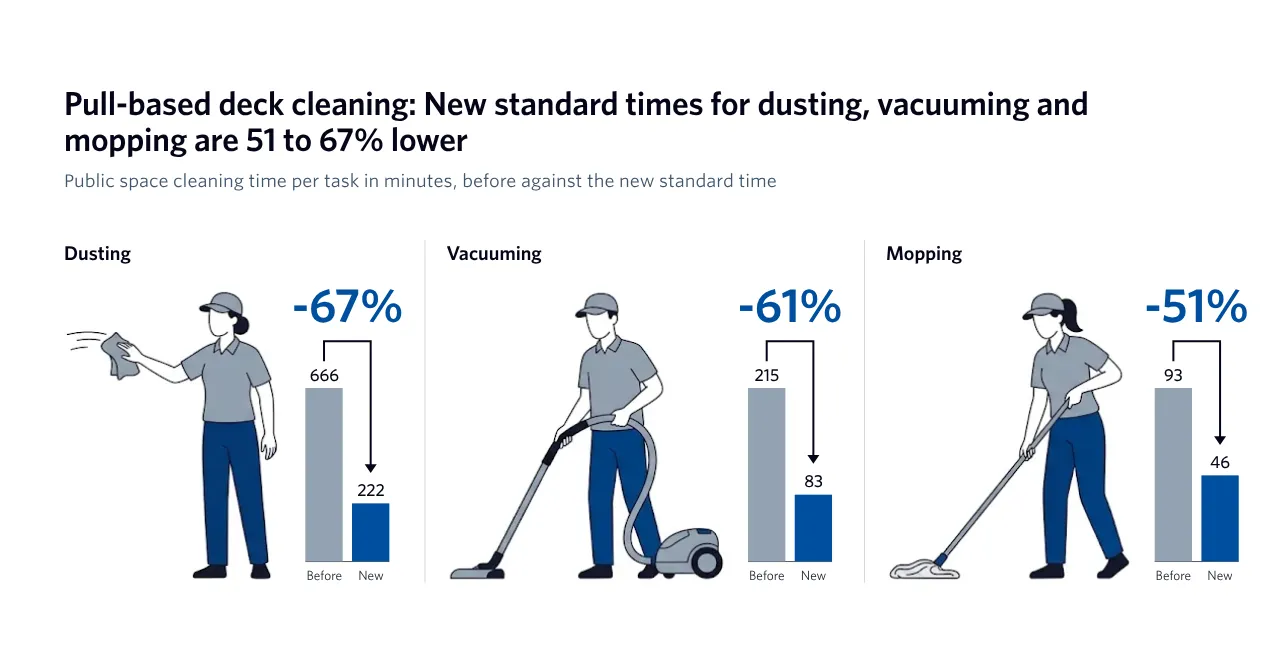
Most ships clean public spaces on a fixed route, whether guests used them or not. We set the cleaning frequency per area by actual demand, leveled the workload across the week and timed it around the daily program. Dusting alone dropped from 666 to 222 minutes.
Dusting the public spaces of one ship took 666 minutes. The new standard time is 222, because each area is now cleaned as often as guests actually use it.
On most cruise ships, public spaces follow a fixed route. The atrium and a quiet corridor on a lower deck get the same frequency, at the same time of day, whatever happened there since the last round. In Lean terms this is push. The plan sets the work, and the deck follows.
Pull turns it around. The cleaning frequency follows how much an area is actually used, and the cleaning time follows the moments when guests are somewhere else.
A demand study across 15 decks
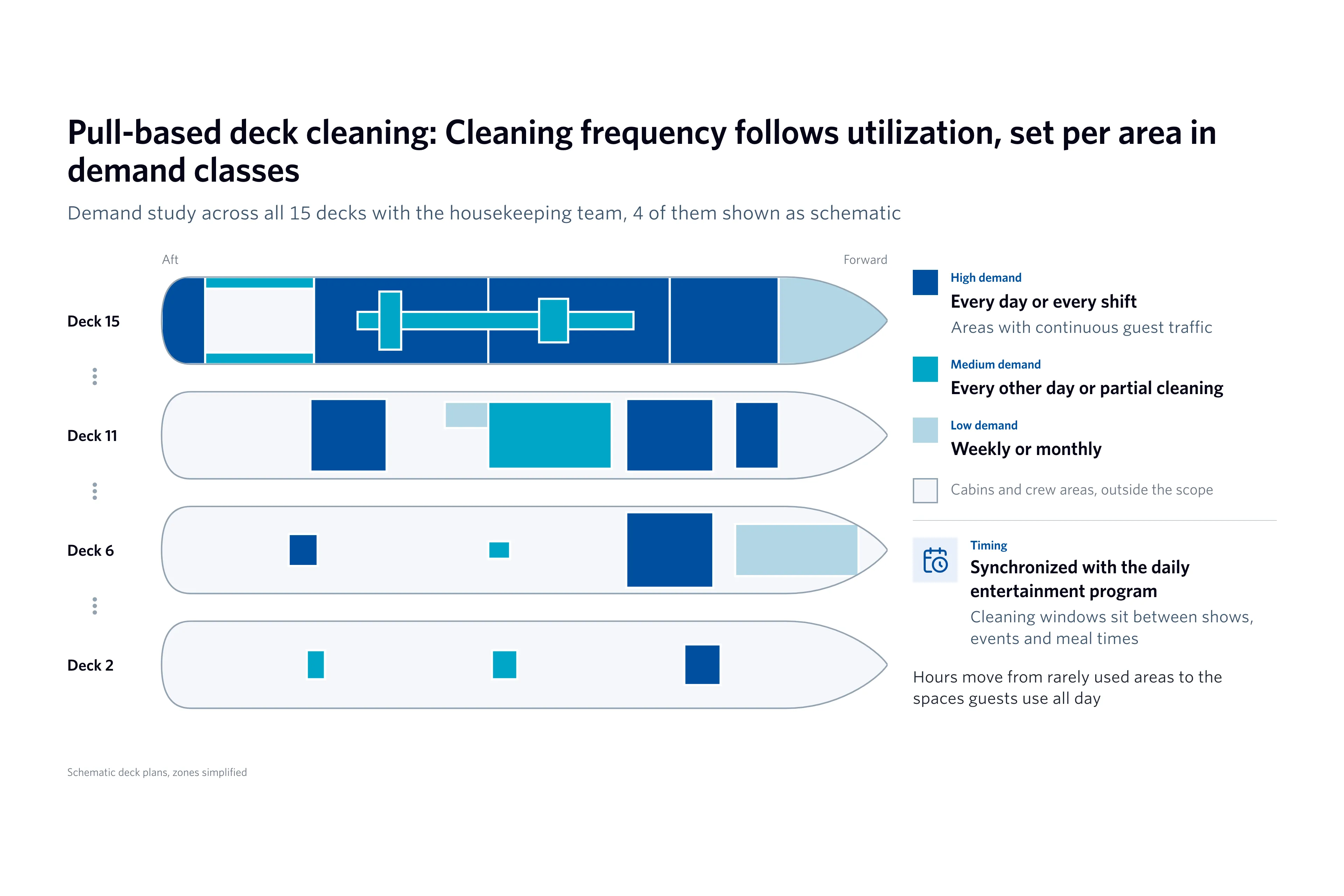
Together with the housekeeping team, we went through all 15 decks and put every public area into one of three demand classes. High-demand areas with continuous guest traffic are cleaned every day or every shift. Medium-demand areas get a round every other day or a partial cleaning. Low-demand areas are cleaned weekly or monthly.
The team knows better than any deck plan where guests spend their day. The study puts that knowledge on paper, area by area.
Leveling the week with Heijunka
Demand classes alone would create a new problem. If every weekly area lands on Monday and every monthly area in the first week, the workload jumps. Some days would need extra crew, others would leave the team short of work.
Heijunka is the Lean principle of load leveling, and it comes from the Toyota Production System. In housekeeping, it means the weekly and monthly rounds are spread across the days, so each day carries a similar share of the work. The mix of areas changes from day to day, while the workload stays about the same. That keeps crew planning stable and turns the demand classes into a plan the team can run every day.
Clean between the shows
The cleaning windows now follow the daily entertainment program. They sit between shows, events and meal times, when the spaces are empty.
Cleaning around guests is slower, and guests see it. When the window opens right after a lounge empties, the same task takes less time and nobody has to step aside for a vacuum cleaner.
Hours also move. What rarely used areas no longer need goes to the spaces guests use all day, so a high-demand area can get more attention than before.
The new standard times
With demand classes, a leveled week and cleaning windows in place, the new standard times are 67% lower for dusting, 61% for vacuuming and 51% for mopping. Across the three tasks, 974 minutes become 351. These standard times are now the planning basis for staffing and the daily housekeeping plan.
What it takes
Forget the 200-page cleaning manual. What made the difference was a demand class for every area, set with the people who clean it every day, a week that carries the same load every day, and cleaning windows that change when the program changes.
Classes also need a regular check, because guest flows shift with itineraries, seasons and refits.
Cabins and crew areas were outside the scope of this study. They follow a different logic, and we have not tested the approach there yet.
If you want to run a demand study on your ship, write to us.
Scope: public spaces across all 15 decks of one ship. Deck plans in the graphic are schematic, zones simplified.